Toll Free: +44 7916 691440
Email: support@academicmaster.co.uk
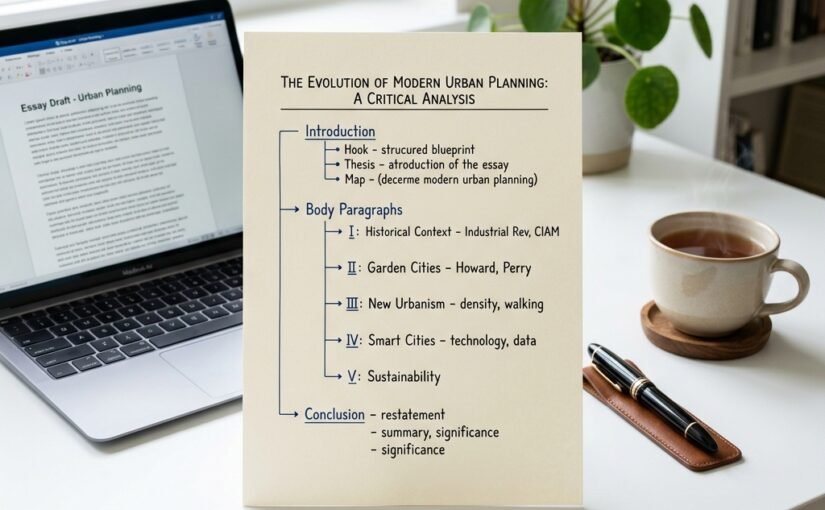
Many students struggle to achieve top marks because they do not understand exactly how to structure a university essay uk style. You might have completed extensive research. You might possess a brilliant central argument. However, if your essay lacks a logical flow, the marker will quickly lose interest. UK universities grade heavily on coherence and organization. Therefore, mastering how to structure a university essay uk format remains the quickest way to boost your degree classification.
A beautifully structured essay acts like a map for the examiner. It guides them effortlessly from your introduction to your final conclusion. Consequently, they never have to guess what point you are trying to make. Every single paragraph serves a specific, undeniable purpose. If you want to stop losing easy marks on your assignments, you must adopt a rigid structural framework. This ultimate guide will break down the exact skeleton you need to build a First-Class academic paper.
Furthermore, learning this structure saves you countless hours of writing time. When you possess a clear blueprint, you avoid the dreaded blank page syndrome. You know exactly what each paragraph must achieve before you even begin typing. Ultimately, this structural framework transforms the chaotic writing process into a simple, predictable formula. Let us explore this powerful academic formula in detail.
Want to know what examiners actually look for? Before you start structuring, make sure you read our comprehensive guide: How to Get a First in a University Assignment.
Before writing a single word, you must establish your word count distribution. A standard university essay follows a strict percentage breakdown. The introduction usually takes up 10% of the total word count. The main body consumes the vast majority at 80%. Finally, the conclusion wraps everything up with the remaining 10%.
If you deviate wildly from this ratio, you will face severe academic penalties. For example, a massive 30% introduction leaves too little room for critical analysis in the body. Conversely, a rushed 5% conclusion feels abrupt and incomplete. Therefore, mapping out your word count in advance prevents structural disasters later on.
Let us break this down mathematically for a standard assignment. If you must write a 2,000-word essay, your introduction should total roughly 200 words. Your main body paragraphs should combine for 1,600 words. Lastly, your conclusion should sit at approximately 200 words. This strict adherence to ratios demonstrates professional academic discipline.
Always check your module handbook before committing to this rule. Some highly specific assignments might require a slightly different distribution. However, in the vast majority of humanities and social science papers, the 10/80/10 rule remains the absolute gold standard for how to structure a university essay uk style. Memorize this ratio immediately.
Many novice writers open Microsoft Word and immediately start typing their introduction. This represents a catastrophic mistake. You cannot build a house without an architectural blueprint. Similarly, you cannot build a First-Class essay without a detailed structural outline. Planning takes time, but it guarantees a cohesive argument.
Your outline should list the main objective of every single body paragraph. If you have 1,600 words for the body, you will likely write six or seven distinct paragraphs. Assign a specific topic to each one of these paragraphs. For example, paragraph one might introduce a core theory. Paragraph two might criticize that same theory.
Furthermore, you must list your academic sources within your outline. Beside each paragraph topic, write down the name of the author you will cite. This ensures you possess enough evidence to sustain your argument. If a paragraph lacks supporting literature in the outline stage, you must delete it or perform more research.
This outlining process forces you to confront logical gaps early. If your argument jumps randomly from topic A to topic C, your outline will reveal this flaw. Consequently, you can insert topic B to bridge the gap before you waste hours drafting unusable text.
Your introduction creates the crucial first impression. It tells the marker exactly what to expect from the rest of the paper. A First-Class introduction accomplishes three specific tasks perfectly. First, it provides brief background context on the topic. Second, it defines any key terms mentioned in the essay prompt. Third, and most importantly, it presents a definitive thesis statement.
A thesis statement outlines your core argument clearly. Do not keep the examiner in suspense. Academic writing is not a mystery novel. You must state your final conclusion right in the opening paragraph. If the examiner has to guess your stance, they will deduct marks instantly. For excellent examples of opening hooks, check the official Oxford University essay guidelines.
Furthermore, you should provide a brief roadmap of the essay. Tell the reader exactly which themes you will explore to prove your thesis. Use phrases like, “This essay will first examine…” followed by “Next, it will analyze…” This explicitly demonstrates your structural control.
Never include detailed evidence or lengthy quotes in your introduction. Keep it broad, clear, and highly focused on the essay question. Your introduction serves merely as the launchpad for your argument. Save your heavy academic artillery for the main body paragraphs.
Struggling to structure your essay? Download our free PDF checklist and paragraph template. It guarantees a logical, high-scoring academic structure.
The main body contains the actual substance of your essay. Here, you must prove your thesis through rigorous critical analysis. When students ask how to structure a university essay uk properly, the answer is always the PEEL paragraph structure. PEEL stands for Point, Evidence, Explain, and Link.
Start with your Point. The first sentence must clearly state the paragraph’s main idea. Next, introduce your Evidence. Provide a peer-reviewed academic source that supports your claim. You might paraphrase a recent study or quote a prominent scholar directly.
Then, you must Explain that evidence. Do not just drop a quote and move on. Critically analyze why that evidence matters. Does this evidence contain hidden biases? Does it contradict an earlier theory? This explanation section earns the highest marks from university professors.
Finally, Link the paragraph back to the overall essay question. This ensures you remain firmly on topic. It reminds the examiner that every single paragraph serves the broader thesis statement. Once you complete the link, you transition into your next point.
Even with perfect PEEL paragraphs, your essay can still feel choppy. To fix this, you must use strong transitional phrases. These phrases connect one paragraph to the next seamlessly. They act as signposts for the examiner, showing them the direction of your argument.
For instance, if you want to introduce a contrasting viewpoint, start the next paragraph with “Conversely” or “In contrast.” If you are building upon a previous point, use “Furthermore” or “Building upon this evidence.” These tiny words make a massive difference in overall readability. A beautifully flowing essay consistently achieves higher marks.
You should also use paragraph-level transitions. The final sentence of one paragraph should softly introduce the concept of the next paragraph. This creates an invisible thread that pulls the reader through your document. Consequently, the examiner reads your essay with effortless speed.
Avoid repetitive transitions. Do not start every paragraph with “Additionally” or “Also”. Vary your vocabulary to demonstrate a sophisticated command of the English language. Keep a list of high-level academic transition words beside your keyboard while you write.
A massive structural error involves writing too much description. If you merely describe what other authors have said, your grade caps at 60%. To achieve a First, you must embed critical analysis into your core structure. Your body paragraphs must evaluate the evidence, not just summarize it.
When you introduce a study, immediately question its methodology. Did the researchers use a tiny sample size? Did they ignore a crucial cultural variable? By structurally placing these critical questions right after the evidence, you force yourself to analyze deeply. This is a foundational pillar of how to structure a university essay uk universities expect.
Furthermore, structurally balance your arguments. Do not only present evidence that supports your thesis. You must dedicate entire paragraphs to counter-arguments. Explain why competing scholars disagree with your stance. Then, critically dismantle their opposing views.
This structural balance proves intellectual maturity. It shows the examiner that you have surveyed the entire academic landscape. You understand the complexity of the topic. Ultimately, this balanced structure separates the great essays from the merely good ones.
The conclusion represents your final opportunity to impress the marker. A terrible conclusion introduces brand new evidence at the last minute. Never do this. Instead, a First-Class conclusion elegantly summarizes the main points you already discussed in the body.
Begin by restating your thesis statement, but use slightly different wording. Then, synthesize your core arguments. Show how the evidence you presented logically proves your initial claim. Remind the reader of the journey you just took them on.
Finally, end with a strong concluding thought. You might suggest an area for future research. Alternatively, you could highlight the broader societal implications of your topic. Leave the examiner with a powerful, memorable final sentence.
Keep your conclusion punchy. Remember the 10/80/10 rule. Do not let your conclusion drag on endlessly. Say what you need to say to wrap up the argument, and then stop writing.
The visual structure of your essay matters immensely. If you submit a massive block of unformatted text, the examiner will dock points for poor presentation. You must utilize structural formatting tools. Use clean paragraph breaks to give the reader’s eyes a rest.
If your university permits it, use subtle headings. Headings instantly break up the text and clarify your structure. However, always check your module handbook first. Some traditional literature departments forbid the use of headings in standard essays.
Furthermore, your reference list represents a vital structural component. It must be formatted flawlessly according to your required style guide. A messy bibliography suggests a messy mind. Conversely, a perfectly structured reference list signals professionalism. It tells the marker that you care about academic standards. Therefore, spend ample time structuring your citations correctly.
Your initial draft will contain structural flaws. This happens to everyone. The magic of a First-Class essay occurs during the structural editing phase. You must read your essay specifically looking for organizational errors.
Check every single paragraph against the PEEL method. Does every paragraph have a clear point? Does every paragraph link back to the thesis? If you find a rogue paragraph that wanders off-topic, you must ruthlessly delete it.
Additionally, check your word counts. Did your introduction swell to 20% of the paper? You must trim it down immediately. Did you only write three sentences for your conclusion? You need to expand it. Structural editing ensures your final submission matches your original blueprint. Every student should know how to structure a university essay uk style before submitting.
Finally, read your essay out loud. This simple technique highlights structural clunkiness instantly. If you stumble over a transition, the examiner will stumble too. Rewrite that section until it flows perfectly.
Mastering academic structure takes years of practice. If your deadline is approaching rapidly, you might not have time to learn these skills from scratch. Many students panic when they stare at a blank page. They know what they want to say, but they cannot organize it.
If you find yourself paralyzed by structural anxiety, you have options. You do not have to submit a chaotic, disorganized paper. Professional assignment writing services exist to solve exactly this problem. You can hire an expert to structure your thoughts for you.
By studying a perfectly structured model answer, you learn the formula intuitively. You see exactly how the expert transitions between paragraphs. You see how they apply the PEEL method in real time. This represents the best essay writing assistance in the UK standard that you can apply to any paper.
EXPERT ACADEMIC CONSULTANCY
Our UK-based academic team works with undergraduate and postgraduate students at every stage — from refining your structure to polishing your final draft. Get expert input tailored to your specific topic and university requirements.
DISCLAIMER
Academicmaster.co.uk provides custom paper writing/rewriting/research services to help students write their academic papers following their university and college guidlines. These papers can be used as a a source of research and reference guide. For more details contact us how to reference the academic papers properly to avoid any plagiarism accusation.