Toll Free: +44 7916 691440
Email: support@academicmaster.co.uk
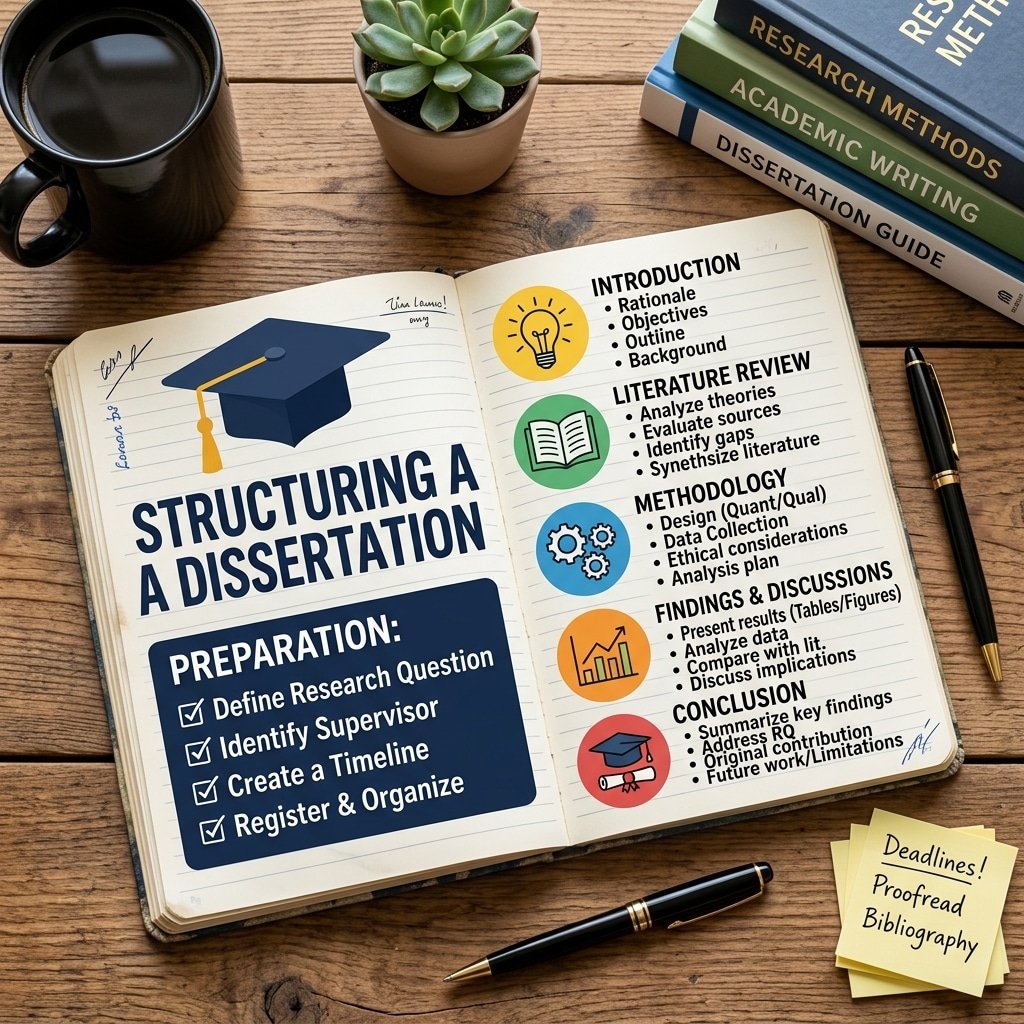
Ask any postgraduate student what their biggest challenge is, and the answer is rarely the complexity of the research itself. Instead, the overwhelming consensus points to the sheer scale of the project. Academics often describe a dissertation as an “academic Everest”. It is a massive, solitary undertaking that tests your project management skills just as intensely as your intellect. Are you grappling with structuring a dissertation? Do you feel crushed under the weight of dissertation writing? It is vital to understand that this feeling is universal. More importantly, it is entirely manageable with the right structural approach.
At Academic Master, our researchers analysed why students often falter during their final year. The data consistently shows two primary culprits: poor time management and structural paralysis. When faced with a massive blank document, the human brain instinctively procrastinates. The task simply appears too large to begin. However, you can break the dissertation down into manageable micro-tasks. Master the art of structuring a dissertation, and you can then dismantle this “academic Everest” into achievable daily goals. The primary issue with embarking on such a large project is that traditional undergraduate education rarely prepares you for it. Throughout your Bachelor’s degree, universities likely assessed you via short-term essays or module assignments. A dissertation, especially at Master’s or PhD level, requires an entirely different cognitive skillset. It demands stamina, long-term vision, unwavering commitment to a central argument, and exceptional organisational skills. If you’re finding the transition challenging, remember that support is available for all your academic commitments. Consider exploring resources like an essay writing service or an assignment writing service if you need assistance balancing your other academic demands whilst focusing on your dissertation.
In this comprehensive guide, specifically tailored for the UK academic context, we will explore the most effective strategies for planning your research, managing your time, structuring your chapters, and maintaining your mental wellbeing throughout the entire research process. From understanding the core components of your literature review to properly articulating your methodology, these actionable techniques will help you cross the finish line with confidence and secure the best possible grade.
Before addressing structural mechanics, we must tackle the psychological barriers that often impede progress. The modern UK university student operates in an environment of unprecedented pressure. You are not only managing your academic workload but likely balancing financial pressures, career anxiety, and the pervasive feeling of “imposter syndrome”—the secret fear that you are not actually capable enough to be undertaking this research in the first place. This fear is insidious because it often masquerades as perfectionism. You tell yourself that you cannot write the introduction today because you have not read enough literature, or because your methodology is not perfectly defined. In reality, you are simply afraid of producing a flawed first draft.
Imposter syndrome breeds procrastination. If you subconsciously believe your writing will not be good enough, you will naturally avoid sitting down to write it. The antidote to this is acknowledging that first drafts are inherently flawed. The goal of your first draft is not to produce distinction-level prose; it is simply to get words onto the page. Once the text exists, it can be refined, edited, and elevated. You cannot edit a blank page. The most successful academics are not necessarily the most naturally gifted writers; they are the most resilient revisers and critical self-evaluators.
The secret to long-term project success lies in the micro-task. Trying to tackle structuring a dissertation all at once is a recipe for failure, as it is a massive, vaguely defined objective. Instead, your daily tasks must be so small and specific that they remove the cognitive friction of starting. When you write “Work on Dissertation” on your to-do list, your brain immediately resists the ambiguity. Work on what chapter, paragraph, or academic source? Ambiguity leads directly to procrastination.
A micro-task approach looks like this: “Summarise the findings of Smith’s 2024 paper on employee retention.” This is a task you can sit down and accomplish in forty-five minutes. By stacking these highly specific micro-tasks day after day, you bypass the overwhelming dread of the larger project. The chapters will begin to assemble themselves almost automatically. You must become a project manager of your own academic life.
If you are struggling to build a schedule that works around your other commitments, securing expert dissertation help can provide the external accountability and project mapping you need to stay on track. Sometimes, having an experienced academic review your timeline can highlight logistical flaws before they become insurmountable delays, especially when facing the complexities of PhD dissertation writing.
A frequent criticism from university markers is that a dissertation reads like five separate essays loosely stapled together, rather than a cohesive piece of academic research. To achieve top marks when structuring a dissertation, you must create a “Golden Thread”—a central argument or research question that remains highly visible from the abstract to the conclusion. This thread is the logical through-line that justifies why you created each chapter and why you placed it where you did. It’s what differentiates a mere compilation of research from a well-articulated thesis, a crucial aspect whether you are working on a Master’s or a Master Thesis Structure.
Ensure that the themes identified in your literature review directly inform the questions you ask in your methodology. Subsequently, ensure that your data analysis chapter explicitly answers those specific questions. If you find yourself discussing a fascinating tangential point in chapter four that does not relate back to your primary research gap identified in chapter two, you must ruthlessly cut it. Cohesion is the hallmark of a distinction-level researcher. Your marker should never have to stop and ask, “Why am I reading this paragraph right now?” The relevance of every single sentence must be immediately apparent.
Expert Insight: “The most common structural flaw we see is the disconnect between the methodology and the analysis. Your methodology promises the examiner a specific way of looking at the data. If your analysis abandons that framework, the entire academic argument collapses.”
While the exact requirements will vary between UK universities and disciplines, the vast majority of social science, humanities, and business dissertations adhere to a standard five-chapter structure. Understanding the distinct purpose of each chapter is critical. You must respect the boundaries of each section; do not start analysing primary data in your literature review, and do not introduce new literature in your conclusion.
The introduction is arguably the most important chapter because it sets the tone for the entire marker’s experience. It must clearly state the research problem, the aims and objectives of the study, and the justification for why this research is necessary. A strong introduction also provides a brief roadmap of the chapters to come. The introduction should ideally be written twice: once at the very beginning to guide your research, and once at the very end to ensure it perfectly aligns with what you actually produced. This chapter typically includes:
The literature review is not merely a summary of everything you have read. Falling into this common trap almost always leads to poor grades. Instead, it must be a critical synthesis. You must identify debates, contradictions, and gaps in the existing academic conversation. Your goal is to construct a theoretical framework that leads logically to the conclusion that your specific research question is the necessary next step in the field’s evolution. For an in-depth understanding, refer to our comprehensive Literature Review Guide.
Your methodology chapter is the blueprint of your research. It must detail exactly how you collected your data, who your participants were, and how you intend to analyse the findings. More importantly, it must justify these choices academically. Why did you choose semi-structured interviews over a survey? Why is a phenomenological approach better suited to your research aims than grounded theory? A robust methodology defends itself against future academic criticism and demonstrates a deep understanding of research design. This is a critical component whether you are approaching a standard Master’s dissertation or aiming for a PhD Dissertation Guide.
This is where you finally present the results of your hard work. The key to a successful findings chapter is avoiding the temptation to simply dump raw data onto the page. Every statistic, quote, or thematic observation must be analysed in the context of your research question. You are not just reporting what you found; you are explaining what it means. Use clear headings and subheadings to organise your results logically. Visual aids like graphs, charts, and tables can be incredibly effective, but ensure they are clearly labelled and referred to in the text.
You must tie off the “Golden Thread” in the final chapter. Bring your findings back into conversation with the literature review you established in Chapter Two. Did your findings confirm existing theories? Did they contradict them? Critically discuss why. Most importantly, what are the theoretical, practical, or policy implications of your research? A strong conclusion also demonstrates academic maturity by openly acknowledging the limitations of the study and offering robust suggestions for future researchers.
If you find yourself lost in the complexities of these chapters, reaching out to experts in dissertation writing service can provide you with bespoke, structurally flawless chapter examples that serve as perfect models for your own work. This ensures you do not waste weeks writing in the wrong direction.
Your supervisor is your primary academic guide throughout your dissertation journey. Establishing a productive working relationship is paramount. They are not merely an editor but a mentor, critic, and facilitator. Regular, prepared meetings are crucial. Come to meetings with specific questions, clear updates on your progress, and a list of areas where you require guidance. Proactively seek feedback on chapter drafts and be open to constructive criticism. Remember, their role is to push you towards academic independence, not to rewrite your work. UK universities place significant emphasis on the supervisory relationship as a cornerstone of postgraduate education.
A frequently overlooked component of structuring a dissertation is the ethical framework. Ethics should not be a brief afterthought tacked onto the end of your methodology chapter; it is a foundational pillar that dictates how you conduct your research from start to finish. UK universities hold postgraduate students to stringent ethical standards, particularly when the research involves human subjects, sensitive data, or vulnerable populations. The ethical considerations section must explicitly address informed consent, the right to withdraw, data anonymisation, confidentiality, and potential harm to participants. Failing to rigorously defend your ethical choices can result in a failing grade, regardless of how insightful your findings might be.
In the digital age, ethical considerations extend to how you store and manage data. You must demonstrate compliance with the General Data Protection Regulation (GDPR) and other equivalent local data laws. Explain where interview transcripts, survey data, and other sensitive materials will be stored, who will have access to them, and when they will be securely destroyed. This level of detail proves to the examiner that you are operating as a professional academic researcher. If your study does not involve human participants—for example, if you are conducting a purely doctrinal legal analysis or a systematic literature Review—you must still include a brief ethical statement clarifying why ethical approval was not required, ensuring the examiner knows you considered the issue.
This brings us to the ethics of referencing and originality. The pressure to produce a high volume of words can sometimes lead to sloppy citation practices. Poor paraphrasing or accidental omission of sources is still considered academic misconduct. When structuring a dissertation, you must include a robust system for tracking citations as you write. Never insert a quote or an idea without immediately adding the corresponding citation. Retroactively attempting to find where a specific statistic came from three weeks later is a nightmare that will severely delay your progress. Utilise reference management software like Mendeley, Zotero, or EndNote from day one to automate your bibliography and maintain a flawless academic record.
A significant new challenge facing modern researchers is the responsible integration of Artificial Intelligence (AI). Over the past few years, the landscape of academic writing has been fundamentally altered by generative software. Many students find themselves paralysed by the ambiguity surrounding these tools. Is using software to check grammar acceptable? What about using AI to summarise large PDFs or generate formatting templates? UK universities are rapidly evolving their policies on AI usage, often leaving students terrified of accidentally breaching academic integrity protocols.
Current UK Academic Stance on AI: While policies are still developing, the general consensus is that AI tools can be used for *supportive* tasks, but not for generating original content or ideas. This means using AI to:
However, submitting AI-generated text as your own, particularly for substantive content, is unequivocally considered plagiarism and academic misconduct. Always check your university’s specific guidance on AI usage. Transparency is key: if you use AI tools, consider citing their use in your methodology or an appendix, as per your institution’s guidelines.
Once you have completed the writing of all your chapters, the journey is far from over. Editing and proofreading are crucial stages that can significantly impact your final grade. A well-written, thoroughly edited dissertation projects professionalism and attention to detail. Conversely, a thesis riddled with grammatical errors, typos, and formatting inconsistencies can undermine even the most brilliant research.
Consider using professional proofreading services if your budget allows. An objective pair of eyes can catch errors you’ve become blind to. Academic Master can provide such support to ensure your dissertation is polished to perfection.
Understanding the expected scale of your dissertation is crucial for effective planning and structuring. While guidelines vary, the following table provides a general overview for common UK postgraduate degrees.
| Degree Level | Typical Word Count Range | Expected Depth & Originality | Supervisor Interaction Level | Focus in Structuring |
|---|---|---|---|---|
| Master’s (MA/MSc) Dissertation | 15,000 – 25,000 words | Demonstrates critical understanding, ability to conduct independent research, contributes to existing knowledge. | Moderate to High; regular meetings, detailed feedback on drafts. | Clear methodology, strong literature review, concise argument. (Refer to Master Thesis Structure) |
| MPhil Thesis | 30,000 – 60,000 words | Significant critical analysis, advanced research skills, often a precursor to PhD, demonstrates potential for original contribution. | High; more independent but still very collaborative with supervisor. | Robust theoretical framework, detailed methodological justification, substantial original analysis. |
| PhD Thesis | 70,000 – 100,000 words (or publication-based) | Substantial original contribution to knowledge, publishable quality, expert-level understanding of field. | High; often partnership, leading to co-authorship on publications. | Exceptional intellectual rigour, groundbreaking findings, clear impact on discipline. (See PhD Dissertation Guide) |
| Professional Doctorate (e.g., EdD, DPhil) | 40,000 – 70,000 words | Original contribution with strong practical application, bridging theory and professional practice. | High; focus on practical implications alongside academic rigour. | Emphasis on real-world impact, practical recommendations, robust justification for applied methodology. |
Structuring a dissertation is undoubtedly one of the most challenging yet rewarding academic endeavours you will undertake. It demands meticulous planning, unwavering perseverance, and a deep commitment to your chosen field. By adopting a structured approach, breaking down the mammoth task into manageable components, and continually reinforcing the “Golden Thread” of your argument, you can navigate this academic Everest with confidence.
Remember, the dissertation is not just a hurdle to overcome; it is an opportunity to contribute original thought to your discipline and to develop invaluable research and project management skills that will serve you throughout your career. Embrace the challenge, seek support when needed, and trust in the process. With Academic Master by your side, your journey to academic excellence is well within reach.
DISCLAIMER
Academicmaster.co.uk provides custom paper writing/rewriting/research services to help students write their academic papers following their university and college guidlines. These papers can be used as a a source of research and reference guide. For more details contact us how to reference the academic papers properly to avoid any plagiarism accusation.