
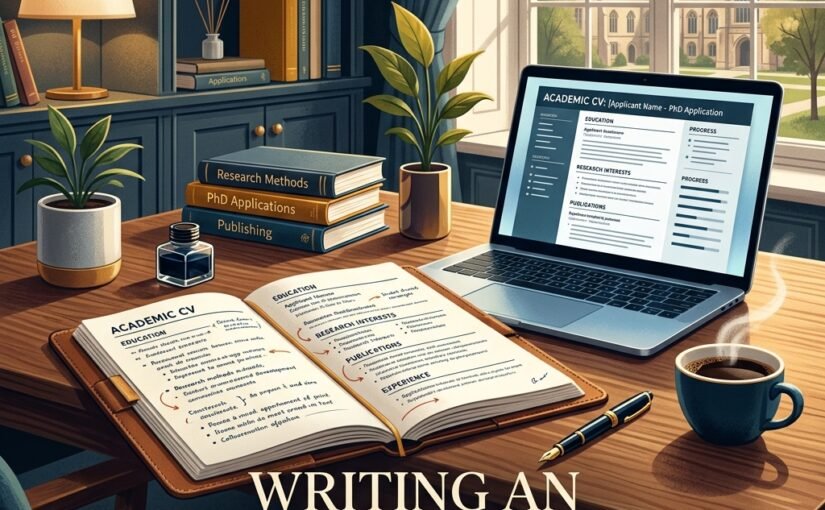
Are you applying for a highly competitive PhD program and struggling to format your academic achievements? Undeniably, writing a standard industry resume is entirely different from crafting a specialized academic Curriculum Vitae. Consequently, knowing exactly how to write an academic CV for PhD applications is a mandatory skill that will dictate your future in academia. Furthermore, admissions committees review thousands of applications annually. Therefore, your document must stand out instantly, demonstrating your precise research capabilities and scholarly trajectory.
The Essentials of PhD Applications
Moreover, an academic CV explicitly prioritizes publications, conference presentations, and research grants over standard corporate work experience. Ultimately, the layout must be strictly chronological, highly detailed, and entirely devoid of generic corporate buzzwords. Students who fail to grasp these rigid conventions often seek out academic cv writing services to ensure their first impression is flawlessly professional.
Throughout this massive 2200-word comprehensive guide, we will meticulously deconstruct every single section required for a top-tier academic CV. From the specific nuances of your educational history to appropriately formatting your upcoming publications, you will learn the exact strategies used by successful PhD candidates across the UK. Additionally, we will cover common formatting errors that instantly result in rejection.
Whether you are transitioning directly from a Master’s degree or returning to academia after years in the industry, the core structural rules remain identical. By mastering these principles, you will drastically improve your chances of securing full funding and acceptance into your dream program.
Secure Your PhD Spot with Elite Assistance
Struggling to perfect your application? Our network of UK-based PhD writers provides specialized dissertation editing services and CV formulation.
1. The Core Differences Between a Resume and an Academic CV
Unlike a standard two-page resume, an academic CV has absolutely no page limit. Indeed, as your scholarly career progresses, your CV will naturally expand to encompass every academic contribution you have ever made. Therefore, early-career researchers must abandon the corporate mentality of “keeping it short.” Instead, the focus shifts to extreme clarity, comprehensive detail, and strict categorical organization. If you need structural assistance, many students rely on professional cheap dissertation writing services to provide comprehensive editorial support across their entire application portfolio.
However, having no page limit does not mean you can include irrelevant information. For instance, your high school summer job as a barista has absolutely no place on a PhD application. The admissions committee is exclusively evaluating your potential to generate high-quality research, secure funding, and contribute to the university’s academic prestige. Everything you include must serve to prove those three specific points.
Structuring the Document
Typically, the document follows a very rigid structural hierarchy. First, you must list your contact information and immediate educational background. Second, you list your research interests, publications, and conference presentations. Finally, you list teaching experience, academic service, and professional affiliations. Deviating from this expected hierarchy forces the admissions committee to hunt for your qualifications, which is a major red flag.
💡 Pro-Tip for Higher Education Standards
Crucial Rule: Never use creative fonts or heavily stylized templates. Academic CVs must be exceptionally plain. Use Times New Roman or Arial, 11-12pt font, and 1-inch margins. The content must speak entirely for itself without visual distractions.
2. Detailing Your Educational History
First and foremost, your education section is the cornerstone of your PhD application. You must list your degrees in reverse chronological order, starting with the Master’s or Bachelor’s degree you are currently completing or have most recently finished. You must include the institution’s name, the degree awarded, the month and year of graduation, and your specific thesis title.
Additionally, it is highly recommended to list the name of your thesis supervisor, especially if they are well-known in your specific academic field. This immediately establishes academic lineage and credibility. Furthermore, if you graduated with honors (e.g., Summa Cum Laude, First-Class Honours), state this clearly alongside your GPA or degree classification.
Highlighting Research Experience
Following your education, your research experience is the most heavily scrutinized section. You must describe any lab work, research assistantships, or independent academic projects you have undertaken. Use strong, academic action verbs to describe your methodology. Did you “synthesize,” “analyze,” “quantify,” or “theorize”? Precision in your language demonstrates methodological competence.
When detailing these experiences, always clarify the outcome. Did this research lead to a publication? Did you present it at a departmental symposium? Concrete outcomes provide empirical evidence of your research capabilities. For students lacking confidence in this area, seeking professional dissertation help during your Master’s can ensure you have high-quality research outcomes to actually place on your CV.
Ensure Flawless Academic Planning
Worried about failing to select a viable topic or structure? Our professional academic editors guarantee perfect thematic structuring, advanced analytical depth, and zero plagiarism.
3. Publications, Presentations, and Awards
If you have published peer-reviewed articles, this section should be placed immediately after your education. Format all citations strictly according to the standard style guide of your discipline (e.g., APA for psychology, MLA for literature, IEEE for engineering). Consistency here is absolutely non-negotiable. If an article is currently under review, list it as “Under Review” or “Submitted,” but never claim a publication that has not yet been accepted.
Presentations are equally important for early-career researchers. List any oral presentations, poster sessions, or guest lectures you have delivered. Again, provide the exact title of the talk, the name of the conference, the location, and the date. This proves to the admissions committee that you are actively engaging with the broader academic community.
4. Tailoring the CV to the Specific Program
While an academic CV is a comprehensive record, the order in which you present your achievements should be tailored to the specific PhD program. If you are applying to a highly research-intensive university, ensure your publications and lab skills are front and center. Conversely, if you are applying for a teaching fellowship alongside your PhD, you must elevate your “Teaching Experience” section to feature more prominently on the first page.
This subtle restructuring demonstrates to the admissions committee that you perfectly understand their specific departmental priorities. It shows you are not simply sending out a generic application, but are highly invested in their specific academic environment.
5. The Importance of Academic Service
Many students overlook the “Academic Service” section. Have you peer-reviewed articles for a student journal? Have you organized a departmental symposium or served on a graduate student council? These activities demonstrate institutional citizenship. Universities want PhD candidates who will actively contribute to the departmental culture, not just hide in a library for four years.
6. Formatting and Proofreading
The visual layout of your CV must be impeccable. Use bolding and italics strategically to draw the eye to your degree titles and university names. Ensure your bullet points are perfectly aligned and your dates are formatted consistently (e.g., all written as “Sept 2023 – Present” rather than mixing formats). A single typographical error can be fatal to a PhD application, as it implies a lack of academic rigor.
7. Frequently Asked Questions (FAQs)
Should I include my photograph on an academic CV?
In the UK and US, you should never include a photograph on an academic CV due to strict anti-discrimination and equal opportunity laws. However, if you are applying for programs in certain European or Asian countries, it may be standard practice. Always verify the specific cultural expectations of the country you are applying to.
What if I have no publications yet?
This is completely normal for undergraduate or Master’s students applying for a PhD. If you lack publications, focus entirely on the rigor of your thesis research, your methodological skills, and any high-level academic projects you have completed. Highlight your capacity to produce publishable work in the future.
The Final Review Process
Ultimately, writing an academic CV for PhD applications is an exercise in rigorous self-documentation. You must present your entire scholarly identity in a highly formalized, easily digestible format. By focusing on academic outcomes, maintaining strict chronological formatting, and tailoring the document to the specific institution, you significantly maximize your chances of acceptance.
Before submitting, always have your current academic supervisor review your CV. They know exactly what admissions committees are looking for and can quickly spot structural errors. To conclude, treat your CV with the exact same level of critical analysis and proofreading that you would apply to your final thesis.
Direct WhatsApp Gateway to UK PhD Editors
Struggling to finalize your PhD application? Connect directly with our UK-based PhD editorial team via WhatsApp for immediate, personalized support today.


