
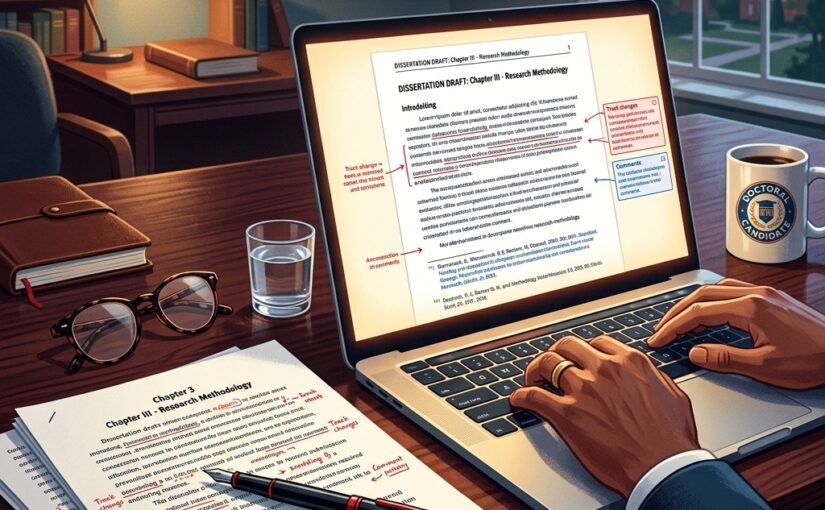
Are you finally approaching the end of your strenuous PhD journey but feeling completely overwhelmed by the editing phase? Undeniably, writing the first draft of your thesis is merely the beginning of the academic process. Consequently, mastering how to aggressively and meticulously edit your own work is the only way to transition a mediocre draft into a first-class piece of scholarly research. Furthermore, professors routinely reject submissions that are conceptually brilliant but structurally flawed.
The Critical Importance of the Revision Phase
Moreover, the revision phase is not simply about fixing minor typos or grammatical errors. Rather, it is a comprehensive overhaul of your argumentation, methodological clarity, and theoretical framework. Ultimately, your document must flow flawlessly from the introduction to the conclusion without any logical gaps. Students who fail to grasp these rigid editing conventions often struggle immensely, ultimately seeking out professional dissertation editing services to ensure their final submission meets stringent university standards.
Throughout this massive 2200-word comprehensive guide, we will meticulously deconstruct every single step required for top-tier academic editing. From the macro-level restructuring of your chapters to the micro-level refinement of your syntax, you will learn the exact strategies used by professional academic editors across the UK. Additionally, we will cover common proofreading errors that instantly frustrate review committees.
Whether you are tackling a 10,000-word Master’s thesis or a 100,000-word Doctoral dissertation, the core structural rules remain identical. By mastering these principles, you will drastically improve your chances of securing a high distinction and impressing your academic supervisors.
Secure a First-Class Grade with Elite Assistance
Struggling to perfect your final draft? Our network of UK-based PhD academics provides specialized editorial reviews and comprehensive dissertation help.
1. The Three Stages of Academic Editing
Unlike writing a standard essay, editing a massive thesis must be broken down into three distinct, highly regulated stages. You cannot simply read from page one to page two hundred and fix everything at once. Indeed, attempting to fix grammar while simultaneously rewriting an entire chapter’s argument is cognitively impossible. Therefore, you must adopt a systematic, multi-pass approach. If you find yourself entirely lost during this stage, you might consider utilizing cheap dissertation writing services to provide structural feedback before you begin your own revisions.
However, assuming you are tackling this independently, you must first execute a ‘Macro-Edit’ focused entirely on structure and argument. Second, you execute a ‘Micro-Edit’ focused on paragraph flow and sentence-level clarity. Finally, you execute a strict ‘Proofread’ focused exclusively on typos, citations, and formatting.
Stage One: The Macro-Edit
During the Macro-Edit, ignore spelling completely. Instead, focus strictly on the overarching narrative of your thesis. Does your literature review actually inform your methodology? Does your methodology logically lead to your findings? Are your conclusions directly answering your initial research questions? You must aggressively cut tangential arguments that do not serve your core thesis, even if they are well-written.
💡 Pro-Tip for Higher Education Standards
Crucial Rule: Reverse outline your chapters. Read each paragraph and write a one-sentence summary of its main point in the margin. If the summaries do not form a logical, sequential argument, your structure is flawed and must be reorganized immediately.
2. Stage Two: The Micro-Edit (Paragraph and Sentence Level)
First and foremost, once the structure is sound, you must dive into the Micro-Edit. This phase involves scrutinizing the transitions between your paragraphs. Does each paragraph logically flow into the next? You must utilize robust transitional phrases to guide the reader through your complex theoretical frameworks.
Additionally, you must evaluate sentence length and complexity. Academic writing often falls into the trap of being overly dense and convoluted. If a sentence runs for four lines, it is too long. Break it down. Furthermore, ensure you are using active voice wherever appropriate, as passive voice consistently weakens academic argumentation.
Eliminating Academic Jargon
While discipline-specific terminology is necessary, excessive jargon obscures your meaning. The goal of academic writing is extreme clarity, not obfuscation. If you can explain a complex concept using simpler language without losing nuance, you must do so. Precision in your language demonstrates supreme intellectual competence. Interestingly, this exact principle of extreme clarity is also the foundation of crafting professional resumes, a skill you can refine via academic cv writing services as you prepare for the post-PhD job market.
Ensure Flawless Academic Planning
Worried about missing a critical structural flaw? Our professional academic editors guarantee perfect thematic structuring, advanced analytical depth, and zero plagiarism.
3. Stage Three: The Final Proofread
If you have successfully completed the macro and micro edits, you are finally ready for the proofread. This is the most tedious but critical phase. You must hunt for missing commas, incorrect verb tenses, and formatting inconsistencies. Crucially, you must verify every single citation in your text against your final bibliography.
A missing citation is technically considered plagiarism by university software. Therefore, you must be absolutely meticulous. Read your thesis backward, sentence by sentence. This psychological trick forces your brain to look at the words individually rather than anticipating the narrative flow, making typos highly visible.
4. Taking Strategic Breaks
While an academic editing phase is intense, working for fourteen hours straight is counterproductive. You will become “text-blind,” meaning you will completely gloss over glaring errors because you have simply stared at the document for too long. You must step away from your thesis for at least 48 hours before beginning the final proofread.
This subtle break resets your cognitive perspective, allowing you to view your writing with the critical eye of an external examiner rather than the defensive bias of the author.
5. Utilizing Text-to-Speech Software
Many students overlook the incredible value of text-to-speech software. Have your computer read your dissertation back to you out loud. You will instantly hear clunky sentences, missing words, and awkward phrasing that your eyes completely missed during silent reading. This is a secret weapon utilized by professional editors globally.
6. Formatting and University Guidelines
The visual layout of your thesis must strictly adhere to your university’s specific formatting guidelines. Ensure your margins are exactly as prescribed, your page numbers are correctly placed, and your heading styles are uniform throughout the entire 100,000 words. A brilliantly written thesis can fail if it violates the rigid institutional formatting rules.
7. Frequently Asked Questions (FAQs)
Should I hire an external editor for my dissertation?
In the UK and US, most universities explicitly permit students to hire external proofreaders, provided they only correct grammar and formatting, not the underlying academic argument. Always verify the specific academic integrity policy of your institution before hiring external help.
How long should the editing process take?
This is highly dependent on the length of the document. For a full PhD thesis, you should allocate an absolute minimum of four to six weeks exclusively for editing and formatting. Rushing this final stage is the primary reason students are asked to resubmit with “major corrections.”
The Final Review Process
Ultimately, editing your dissertation like a pro is an exercise in rigorous self-discipline. You must present your entire scholarly argumentation in a highly formalized, easily digestible format. By focusing on structural integrity, maintaining strict paragraph transitions, and systematically proofreading the text, you significantly maximize your chances of passing your viva with zero corrections.
Before submitting, always have a peer review your introductory and concluding chapters. They can quickly spot logical gaps that you have become blind to. To conclude, treat your editing phase with the exact same level of academic dedication that you applied to your primary research.
Direct WhatsApp Gateway to UK PhD Editors
Struggling to finalize your PhD application or thesis? Connect directly with our UK-based PhD editorial team via WhatsApp for immediate, personalized support today.


