Toll Free: +44 7916 691440
Email: support@academicmaster.co.uk
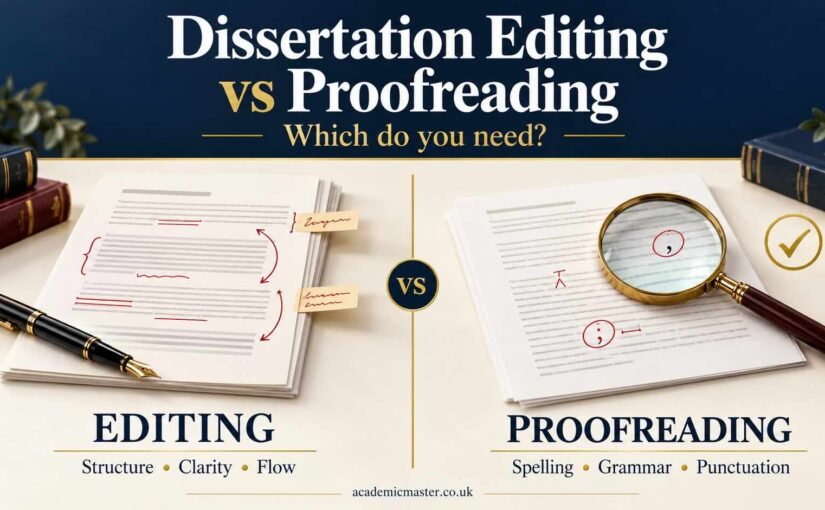
“Dissertation Editing and proofreading” are often used as if they mean the same thing, but they fix very different problems. Book the wrong one and you’ll pay for changes your dissertation doesn’t need, or miss the ones it does.
| Editing | Proofreading | |
|---|---|---|
| Fixes | Structure, argument, clarity, flow, academic tone | Spelling, grammar, punctuation, formatting, references |
| Best stage | After your full first draft | Final check before submission |
| Level of change | Paragraph and sentence level, with comments | Word level |
| Takes longer? | Yes: it needs subject knowledge | No: it’s a surface check |
An editor reads your dissertation as an examiner would. Expect feedback and changes on:
A proofreader checks the surface of the text:
Choose editing if your supervisor’s feedback mentions structure, argument or “lack of critical analysis”, or if your draft feels disjointed.
Choose proofreading if your content is final and approved, and you only need a clean, error-free copy.
Most students benefit from both: editing after the first full draft, then proofreading just before submission.
Under most UK university proofreading policies, an editor can’t rewrite your argument or add new content for you. A professional service works within those rules and tracks every change so you stay in control. Check your university’s policy before you book.
Our dissertation editing services are carried out by UK editors with master’s and PhD degrees, with tracked changes and comments on every chapter. If you need support earlier in the process, see our dissertation help service. To edit it yourself first, read the ultimate guide to editing your dissertation.
Yes, because it takes longer and needs subject knowledge.
Yes. Many students start with the literature review or discussion.
Many universities allow proofreading within set limits. Check your university’s policy and declare it if required.
DISCLAIMER
Academicmaster.co.uk provides custom paper writing/rewriting/research services to help students write their academic papers following their university and college guidlines. These papers can be used as a a source of research and reference guide. For more details contact us how to reference the academic papers properly to avoid any plagiarism accusation.