Toll Free: +44 7916 691440
Email: support@academicmaster.co.uk
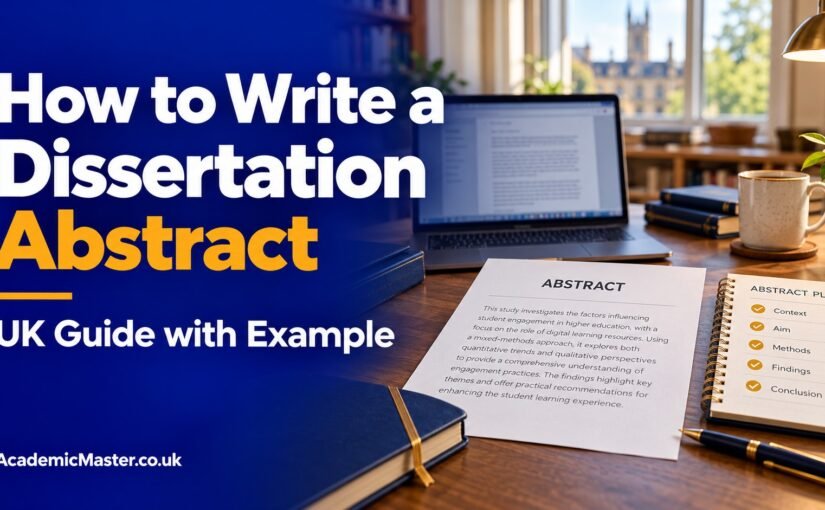
The abstract is the shortest part of your dissertation, yet it is the part most people read first. Your marker reads it before anything else, and it shapes their first impression of your whole project. A clear, well-structured abstract signals that you understand your research and can explain it concisely – a key mark of a first-class dissertation.
This guide explains exactly how to write a dissertation abstract for a UK university: what to include, how long it should be, a step-by-step method, a worked example, and the mistakes that cost students marks.
A dissertation abstract is a short, self-contained summary of your entire dissertation. It sits on its own page after the title page (and acknowledgements, if you have them) and before the table of contents. In one or two paragraphs it tells the reader what you studied, why it matters, how you did it, what you found and what it means.
Think of it as your whole dissertation in miniature. A reader should be able to understand the core of your research from the abstract alone, without reading any other chapter.
Most UK universities ask for an abstract of 150–300 words for undergraduate and master’s dissertations. PhD theses sometimes allow a little more. Because requirements differ between universities and departments, always check your module handbook first – going over the word limit is an easy way to lose marks.
As a rule of thumb, write the abstract as a single page that fits comfortably within your institution’s limit, usually in one paragraph.
A strong abstract covers five elements, normally in this order:
A useful guide is to give roughly one or two sentences to each element, with the most space going to your findings – this is the part readers care about most.
Although the abstract appears first, write it after you have finished every other chapter. You cannot summarise findings and conclusions accurately until they are final. Writing it last also helps it match the rest of your dissertation exactly.
Reread your introduction, methodology, results and conclusion. Highlight the single most important sentence or idea from each. These become the raw material for your first draft.
Turn your highlights into a rough draft that covers context, aim, method, findings and implications. Do not worry about the word count yet – focus on getting the logic and flow right.
Vague statements such as “the results are discussed” add nothing. Replace them with what you actually found: “Students who used weekly feedback scored 12% higher on average than those who did not.” Specific findings make your abstract more convincing and more useful.
Remove background detail, citations, abbreviations you have not explained, and filler phrases. Each sentence should earn its place. Then check the word count against your handbook.
Use the past tense for what you did and found (“This study examined…”, “The findings showed…”) and the present tense for conclusions that remain true (“These results suggest…”). Include the main keywords of your topic so the abstract is easy to find in university repositories and databases.
Below is a short example abstract for a fictional master’s dissertation in education (around 180 words). Notice how each sentence covers one element.
Feedback is widely regarded as central to student learning, yet many UK undergraduates report that written feedback is too slow to be useful. This study investigated whether weekly formative feedback improves the academic performance and confidence of first-year business students. A mixed-methods design was used: assessment scores were compared between a group receiving weekly feedback (n = 64) and a group receiving end-of-term feedback only (n = 58), and 12 participants took part in semi-structured interviews. Students receiving weekly feedback achieved significantly higher final marks and reported greater confidence in planning their assignments. Interview data suggested that timely feedback helped students correct mistakes before they became habits. However, students also noted that feedback was only useful when it included clear next steps. The findings suggest that universities could improve outcomes by adopting short, regular feedback cycles rather than relying on end-of-term comments. Further research is recommended to test this approach across other disciplines and year groups.
Students often confuse the two. The table below shows how they differ.
| Feature | Abstract | Introduction |
|---|---|---|
| Purpose | Summarises the whole dissertation | Sets up the research and leads into it |
| Length | Usually 150–300 words | Often around 10% of the total word count |
| Includes findings? | Yes – key results and conclusions | No – findings come later |
| When to write | Last | Drafted early, revised at the end |
| Citations | Normally none | Yes – sets the research in context |
Before you submit, check that your abstract:
No. An abstract normally contains no citations. It summarises your own research, so all supporting references belong in the main chapters.
In most UK universities the abstract is excluded from the dissertation word count, along with the reference list and appendices. However, policies vary, so confirm this in your handbook.
Usually, yes. Most abstracts are written as a single paragraph. Some disciplines, particularly in health and the sciences, use a structured abstract with short headings such as Background, Methods, Results and Conclusion.
A sharp abstract can lift the impression your whole dissertation makes. If you are short on time or want an expert to check that your abstract, introduction and conclusion work together, our dissertation editing service can review and refine your work. For broader support, explore our UK dissertation writing services or read our guide on structuring a dissertation and how to get a first-class dissertation.
You must be logged in to post a comment.
DISCLAIMER
Academicmaster.co.uk provides custom paper writing/rewriting/research services to help students write their academic papers following their university and college guidlines. These papers can be used as a a source of research and reference guide. For more details contact us how to reference the academic papers properly to avoid any plagiarism accusation.




Pingback:How to Write a Dissertation Introduction: 6 Steps + Examples
Pingback:How to Write a Dissertation Conclusion (UK Guide + Example)