
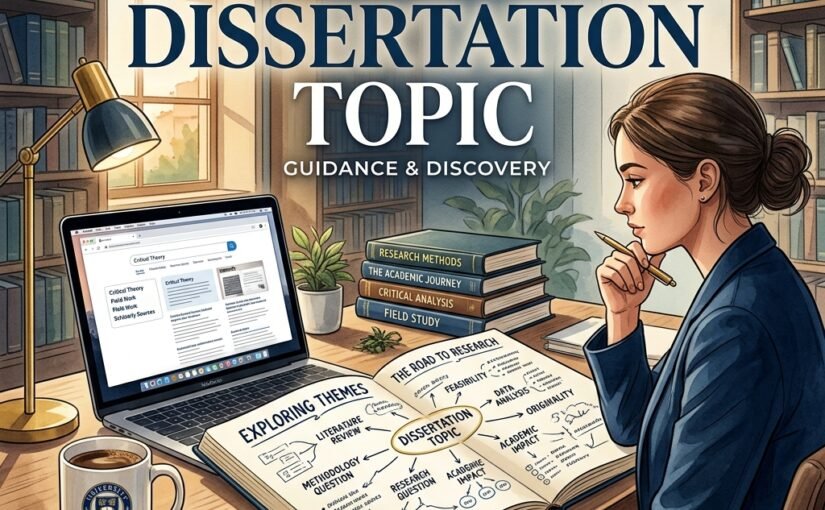
Are you currently struggling to narrow down your academic interests into a single, cohesive research question? Indeed, selecting the perfect research focus is often the most paralyzing stage of the entire academic journey. Consequently, our comprehensive guide on how to choose a dissertation topic is meticulously designed to help UK university students navigate this critical phase and achieve top grades. Furthermore, your topic is the foundational pillar of your entire undergraduate or postgraduate project. Despite its immense importance, many students lose crucial time due to poor brainstorming, lack of academic relevance, or selecting ideas that are far too broad to analyze effectively. Therefore, mastering how to choose a dissertation topic will fundamentally transform your approach to the entire research process.
The Fundamentals of Topic Selection
In addition, a robust research question not only demonstrates your understanding of the field but also signals to your external examiners that your project addresses a genuine gap in current knowledge. Ultimately, by following this complete guide on how to choose a dissertation topic, you will learn exactly how to seamlessly narrow your scope while maintaining flawless academic integrity.
Throughout this extensive 2200-word guide, we will break down every single component of the topic selection process. From the initial stages of mind-mapping scholarly interests to the final phases of consulting with your supervisor, you will discover the exact strategies employed by top-tier academics. Many students look for dissertation help to assist them, but learning these brainstorming skills yourself is incredibly rewarding. We will explore feasibility, relevance, originality, and how to maintain your own academic voice amidst a sea of existing literature.
Whether you are planning a 10,000-word undergraduate thesis or a 50,000-word PhD dissertation, the principles of excellent topic selection remain identical. It requires patience, meticulous organization, and a highly critical eye. By the end of this comprehensive article, you will have a clear, step-by-step roadmap to navigate the complexities of formulating a winning thesis idea.
Accelerate Your Assignments with Elite
Academic Support
Feeling overwhelmed by complex academic requirements? Our network of 500+ UK-based PhD writers provides specialized academic writing support to craft flawless, first-class proposals.
1. Understanding the Core Mechanics of a Strong Topic
Unlike a standard essay prompt, a proper dissertation topic explicitly relies on addressing an unresolved debate or gap in current literature. As a result, this focused structure ensures readers can immediately identify the academic value of your project without breaking their reading flow.
However, when managing complex assignments—especially major final-year projects—maintaining this specific analytical focus can quickly become overwhelming. For example, the sheer volume of potential ideas, textbooks, and web sources can create a logistical nightmare for researchers. Moreover, a critical component of knowing how to choose a dissertation topic is emphasizing absolute feasibility over mere ambition. Thus, whether you are analyzing a single paradigm or multiple competing theories, your critical boundaries must undoubtedly remain strong throughout your entire project.
To truly understand the mechanics, you must view your topic as a conversation starter. You are stepping into a room where scholars have been debating a general subject for decades. Your job is not simply to repeat what they have discussed, but to analyze their arguments, point out a specific flaw, and formulate a question that addresses it. This level of critical engagement is exactly what top universities expect from their students.
The Narrowing Process: The Golden Rule
Whenever you evaluate potential ideas, narrowing them from a broad subject to a highly specific question is absolutely mandatory. Specifically, this funneling format requires you to identify common trends and then focus on a tiny, unexplored niche. Accordingly, mastering this organization is the first vital step when learning how to choose a dissertation topic.
• Broad Subject: e.g., Climate Change.
• Specific Field: e.g., Climate Change and UK Agriculture.
• Niche Topic: e.g., The impact of post-Brexit agricultural subsidies on sustainable farming practices in Yorkshire.
By strictly adhering to these narrowing strategies, your topic will transition from a disjointed idea into a powerful, cohesive research question. Consequently, your examiners will easily be able to understand your line of reasoning.
💡 Pro-Tip for Higher Education Standards
Crucial Rule: If you are finalizing an idea, you must explicitly confirm that adequate primary or secondary data is accessible. Otherwise, failure to adhere to this rule frequently results in a disjointed project that hits a brick wall halfway through. Always prioritize feasibility over ambition.

2. Structuring Your Feasibility Analysis
First and foremost, your chosen topic must clearly identify the “gap” in the current academic literature while remaining achievable. Furthermore, it is a common misconception among early-career researchers that a dissertation must change the world. In reality, a dissertation is strictly confined to demonstrating your ability to conduct independent, valid research within a very limited timeframe.
Identifying this balance is often the most challenging aspect for students. You must read extensively and critically to spot what has not been done, but also what can be done by a student in six months. Has a certain demographic been ignored? Is a popular methodology outdated? Identifying these flaws is crucial.
Compare and Contrast Ideas
Generally, you must highlight where your interests lie and where the academic gaps exist. By pinpointing intersections between your passion and academic necessity, you demonstrate a deep understanding of the research landscape. When Idea A is interesting but heavily researched, and Idea B is boring but highly relevant, it is your job to evaluate a middle ground. This comparative approach is the hallmark of advanced academic planning.
Additionally, do not be afraid to take a stance on your methodological preferences early on. While you must remain objective, you are allowed to conclude that a qualitative study is more achievable for you than a quantitative one based on your skills. This level of self-awareness in your planning will significantly boost your final success rate.
Ensure Flawless Academic Planning
Worried about failing to select a viable topic? Our professional cheap dissertation writing services guarantee perfect thematic structuring, advanced analytical depth, and zero plagiarism.
3. Advanced Strategies for Finding Inspiration
Before you can write a comprehensive proposal, you must first gather necessary inspiration. Consequently, knowing where and how to search for high-quality academic ideas is a vital skill. Start by utilizing your university’s digital library portal, as this grants you access to premium databases like JSTOR, Scopus, and Web of Science. Look at the “Limitations and Future Research” sections of recently published papers; these are literal goldmines for topic ideas.
Furthermore, mastering Boolean search operators (AND, OR, NOT) will drastically improve the efficiency of your literature search. Instead of typing broad phrases, use specific keywords related to your general interests. For example, searching for “climate change AND economic impact NOT agriculture” will yield highly targeted results that spark unique ideas.
4. A Deep Dive into Supervisor Dynamics
When you are attempting to finalize a topic, having a rigid evaluation framework is essential, but supervisor approval is paramount.
Early Engagement: How early should you contact them? In fields like medicine or computer science, lab space requires booking months in advance. In history or literature, early conceptual approval is highly relevant. Understanding this distinction is why professional UK dissertation experts advise scheduling meetings the moment you have a top-three list of ideas.
Receptiveness: Does this supervisor actually research your area of interest? It is incredibly easy to fall down a rabbit hole of interesting but tangentially related research only to find no faculty member can grade it accurately. If a topic does not directly align with faculty expertise, consider tweaking it immediately. This ruthless pragmatism is what separates a 2:1 from a First-Class thesis.
5. The Role of Theoretical Originality
A dissertation topic does not just summarize facts; it often establishes a new theoretical framework for your field. A theoretical framework is the specific lens through which you will analyze your data. Your topic must allow room to explore the history of these theories and justify why you have chosen one over the others.
This is often the most intellectually demanding part of the planning phase. Synthesizing abstract theories requires a deep, nuanced understanding of the subject matter.
6. The Psychological Toll of the Blank Page
It is crucial to acknowledge the immense psychological toll that choosing a topic can take. “Imposter syndrome” is rampant among postgraduate students. When you are reading the brilliant work of established academics all day, it is easy to feel that your own ideas are insignificant. Remember that every great scholar started exactly where you are now.
Break the task down into manageable chunks. Do not sit down with the goal of “choosing my dissertation topic.” Sit down with the goal of “brainstorming five variables related to cognitive behavioral studies.” By micro-tasking, you maintain momentum and avoid writer’s block. If the anxiety becomes truly unmanageable, there is no shame in seeking external support to alleviate the pressure and guide you across the finish line.
7. Frequently Asked Questions (FAQs) About Topic Selection
Can I change my topic halfway through?
The flexibility of your topic varies wildly depending on the academic level and the overall timeframe of the thesis. As a general rule of thumb, minor tweaks to the methodology or specific variables are common and expected. For a massive PhD thesis, the focus could easily shift during the first year. However, completely changing the subject matter three months before the deadline is a recipe for disaster. If you are struggling to maintain your word count without relying on repetitive filler text due to a poor topic, consulting with professionals for structural guidance can provide strategies for expanding your analytical depth rather than abandoning the project entirely.
Should I choose a topic I am passionate about, or one that is easy?
In traditional UK academia, the intersection of passion and feasibility is the sweet spot. The focus should remain entirely on empirical data and completing the degree, not just pursuing a hobby. Instead of saying, “I love this topic so I will do it,” you should ask, “Is there enough data available for me to finish this on time?” This objective, pragmatic tone sounds far more authoritative and academic. However, spending hundreds of hours on a topic you despise is equally destructive. Always check your specific departmental guidelines and access to resources. When in doubt, thesis writing services can ensure your proposed idea perfectly matches the strict conventions and achievable timelines of your specific academic field.
The Impact of a Perfect Topic on Your Final Grade
Typically, university grading rubrics dedicate significant implicit marks to the originality and feasibility of the chosen research question. Consequently, a meticulously crafted proposal can actually mean the difference between a 2:1 and a First-Class classification. Overall, by internalizing the principles outlined in this guide on how to choose a dissertation topic, you are actively safeguarding your academic performance before you even begin writing.
Finally, for researchers grappling with the immense pressure of narrowing down hundreds of potential ideas, allocating dozens of hours to brainstorming represents a severe cognitive load. Instead, by delegating these initial structural tasks to specialized academic platforms offering premium dissertation help, students can efficiently redirect their intellectual energy toward primary data collection. Ultimately, selecting a topic does not have to be an intimidating hurdle. To conclude, embrace pragmatic analysis, double-check your resource availability, and submit your proposal with absolute confidence.
Join the Academic Discussion
Additionally, for further insights and community discussions regarding academic conventions, we highly recommend checking out our related academic resources. For instance, you can explore our latest publications and join our growing community of researchers by visiting our official Substack newsletter.
We are also proudly featured across the web by esteemed authors who recommend our comprehensive academic strategies. You can read more about elite academic writing on this featured author page at Home Business Mag. Consequently, engaging with these external resources provides an even broader perspective on university grading expectations and top-tier scholarly excellence. Our commitment to providing exceptional academic guidance is recognized across multiple educational platforms.
Direct WhatsApp Gateway to UK PhD Editors
Struggling to finalize your topic proposal? Connect directly with our UK-based PhD editorial team via WhatsApp for immediate, personalized academic writing support today.


